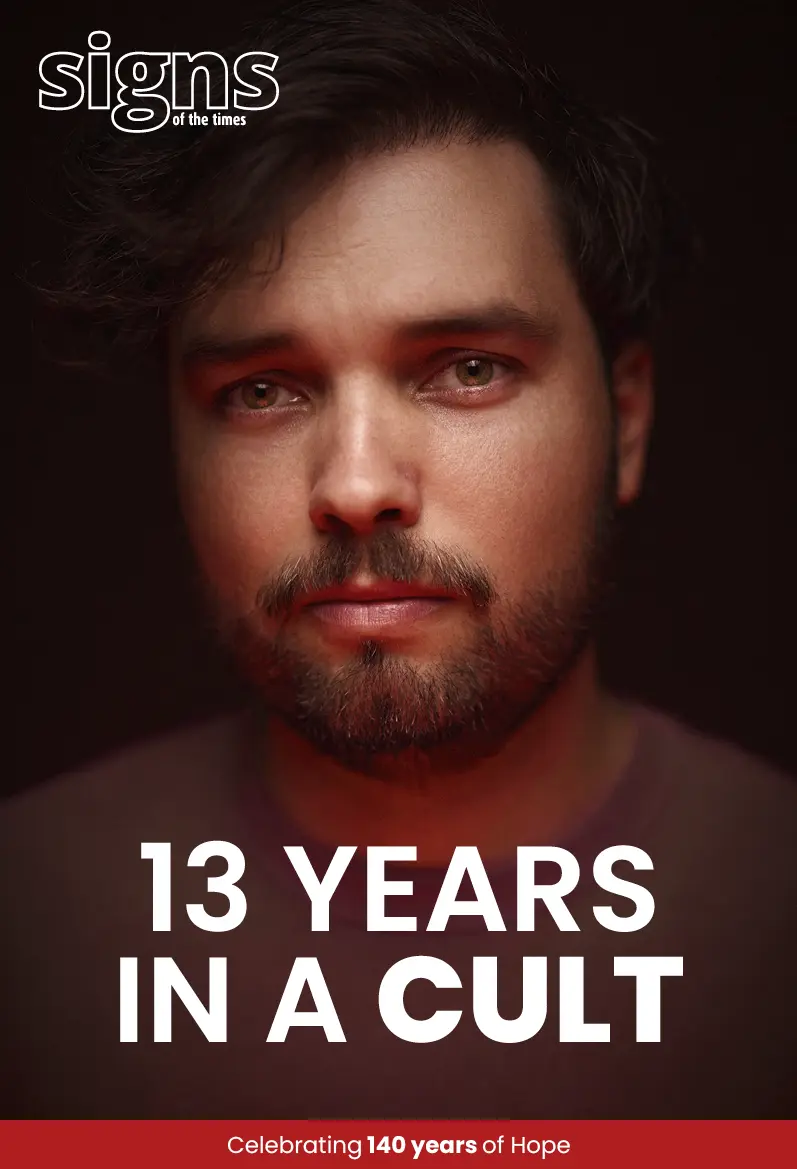

Religion scares me.
When I was 14 years old, my family became involved in a small Christian cult led by a few men who seemed to be the only ones with insider information about the end of the world and current events. “It’s happening as we speak,” they would say. “Time is running out.” They referred to these periods as “the close of probation” in which they believed people had one last chance to choose God’s side, obey His commands and avoid eternal suffering.
I had tried a thousand times to be saved. I responded to numerous altar calls and wept as preachers prayed over me. I was terrified of being lost but didn’t know how to prevent it. All my efforts felt in vain. In the church I was in, Jesus was often portrayed as just another character in the narrative, but certainly not the main character. For many years, I didn’t understand who He truly was or what He wanted from me—aside from strict obedience.
During my teenage years, I frequently experienced what I believed to be the close of probation. Cult leaders regularly updated us, claiming that time was up, “it” had happened, and our characters were now forever unchangeable. Yet the news constantly shifted as more “insights” were received. This left me in a constant state of panic, feeling again and again as though everything was over.
This was one of six church groups I would eventually be involved with, each clinging to its own set of peculiar teachings. But they were essentially all the same.
living in fear
A pattern emerged from my experiences in these groups. I was traumatised by fear of torment and held to impossibly high standards of perfectionism. I spent every moment striving for something I could never attain, only to be denied the healing and wholeness I desperately sought. I was taught that all of this—the fear and the striving—was God’s way of testing the persistence and patience of His followers. And if I didn’t receive what I prayed for, it was proof that I simply wasn’t committed enough.
Roughly five years after first becoming involved in high-control groups, I transitioned into yet another elite sect. This time, it wasn’t just a few free-range, self-appointed leaders. I was baptised into a closed, systematic denomination. Like many other churches, they proclaimed, “We are the remnant people of God, the only true church.” Only they took this to a new level by claiming that they were the chosen few tasked with enlightening the world.
Often it’s toxic religion that breeds the most bitter opponents of faith
I underwent a year of intense study and indoctrination before receiving the hand of fellowship, my name added to the hallowed Excel spreadsheet of official members. I then attended their Bible school to learn the nuances of “undefiled biblical teaching”. During that time, I endured the tyranny of revered leaders and rigid, narcissistic men who demanded conformity to their image. Those who failed were shamed and dehumanised. Sadly, I was in too deep to recognise that this wasn’t normal—it was all a part of being “broken in”.
While at this school, I received the devastating news that my best mate had died. I was in complete shock and felt utterly alone in my grief. When I asked the head minister for two days off to attend his funeral, he told me I wouldn’t graduate if I went. I stood there stunned as he turned away quoting the scripture, “Let the dead bury the dead.” I was sent straight back out to work.
For the next few years, I was closely monitored to determine if I was worthy to be a part of the church. When I was finally accepted, I worked over 15 hours a day, surrendered my intuition and conformed to their mould, believing all this hardship would one day prove my worthiness. Everything I did was controlled—from the music I could listen to, to the food I could eat, to the length of my hair and even aspects of my relationship with my wife.
the breaking point
The pressure and expectations became overwhelming and I eventually had a complete breakdown. After 13 years trapped in this vicious cycle, I reached a point where I hated myself and resented God. I remember crying out to Him, “Why am I constantly fighting a losing battle?” My anger toward Him grew, as did my bitterness towards the church. It was only then that I began to question the impact the organisation was having on my life. Thankfully, a few former members started sharing their experiences publicly, and I could see myself in their stories.
The more I learned about the origins of the movement, the disorder surrounding its beginnings and the horrific stories of others, the clearer it became how narrow and distorted the narrative I’d been fed was. I was able to look back and notice how I’d been discouraged from thinking critically or independently and trained to accept a prescribed set of beliefs and values.
Finally, I stepped down from my pastoral training role and to this day, I have never returned to that church. Surprisingly, what followed was one of the darkest periods of my life. After being recruited into a high-control group and indoctrinated to accept the church’s exclusive claims, breaking away felt profoundly unsafe. No barbed wire fences were needed in this kind of environment; fear-based phobias were intentionally used to ensure compliance and control operated my mind.
As the historian Lord Acton famously observed, “Power tends to corrupt, and absolute power corrupts absolutely.” Over time, I began to see that the problem was what happens when too much power sits in the hands of a few and no-one is allowed to question it.
We often imagine cults as strange, uniformed groups, brainwashed to the point that people are unable to think for themselves. In reality, many of them hide in plain sight and don’t look strange at all.
types of control
A destructive cult is best understood through the BITE model developed by Dr Steven Hassan, a leading cult expert. BITE stands for:
- Behaviour control: Regulating daily life, including sleep, food, clothing, money, relationships, work and media.
- Information control: Withholding or distorting information and limiting access to outside sources.
- Thought control: Discouraging critical thinking, questioning or doubt, and reshaping a person’s sense of reality.
- Emotional control: Restricting acceptable emotions, using shame or fear, and discouraging feelings like sadness, anger or homesickness.
These kinds of control can come from anyone—spouses, families, churches, friends or bosses. It often hides behind language of love, loyalty or “God’s will.” Questioning is treated as dangerous, individuality as risky and obedience as virtue. Identifying these red flags early is crucial to protecting yourself from spiritual abuse.
It’s also important to understand that cults rarely target just anyone. They seek people in vulnerable phases of life—after trauma, loss, relocation, financial stress or loneliness—offering something promising that feels like community, belonging and purpose.
For many I know personally, the consequences were severe: mental breakdowns, hospitalisation or walking away from faith and spirituality altogether. You might wonder why I didn’t leave it all too. During the period in which I was questioning everything, I met many kind and loving Christians outside of the cult—people I had been taught to fear and avoid.
In this season, I came to experience and know God in a way I never had before—as a kind and loving Father. When I was at my lowest, searching for truth, I felt confused about how I had ended up in that place and deeply let down by Him. One night, overwhelmed and desperate, I went outside and cried, “Where are you God? Why don’t You answer me? Don’t You see what I’m going through?” In that moment, I sensed His presence comfort me like a warm embrace. Then I heard a voice—not an audible one but unmistakably clear—say, “I feel everything you feel right now.”
That night marked a radical shift in my understanding of God. I started to realise that He is not a God who micromanages, coerces or controls our decisions. Rather, He allows us to navigate the cause-and-effect realities of our own choices. He is deeply compassionate, present, patient and committed to a relationship built on trust. If we allow Him, He will speak to us gently and guide us through our thoughts and intuition.
We often assume science and atheism are the biggest contributors to disbelief in God, but often it’s toxic religion that breeds the most bitter opponents of faith.
While Jesus gave teachings and principles in the Bible, He invites people to follow Him voluntarily. Embracing His teachings is very different from imposing them on to others; no one has the right to control another person’s thoughts or decisions.
freedom
Becoming enmeshed in a cult was one of the most painful and difficult seasons of my life—one I have often wished away. Yet God has used even the hardest parts of my stories to bring healing, wholeness and goodness—for both myself and others. He desires nothing more for you and me than a life filled with true wellbeing.
Today, my life is more beautiful than I ever imagined it could be, and God is far better than I was ever led to believe. I have come to see that where God is, there is freedom—and that freedom is always an invitation, an offer with no strings attached.