
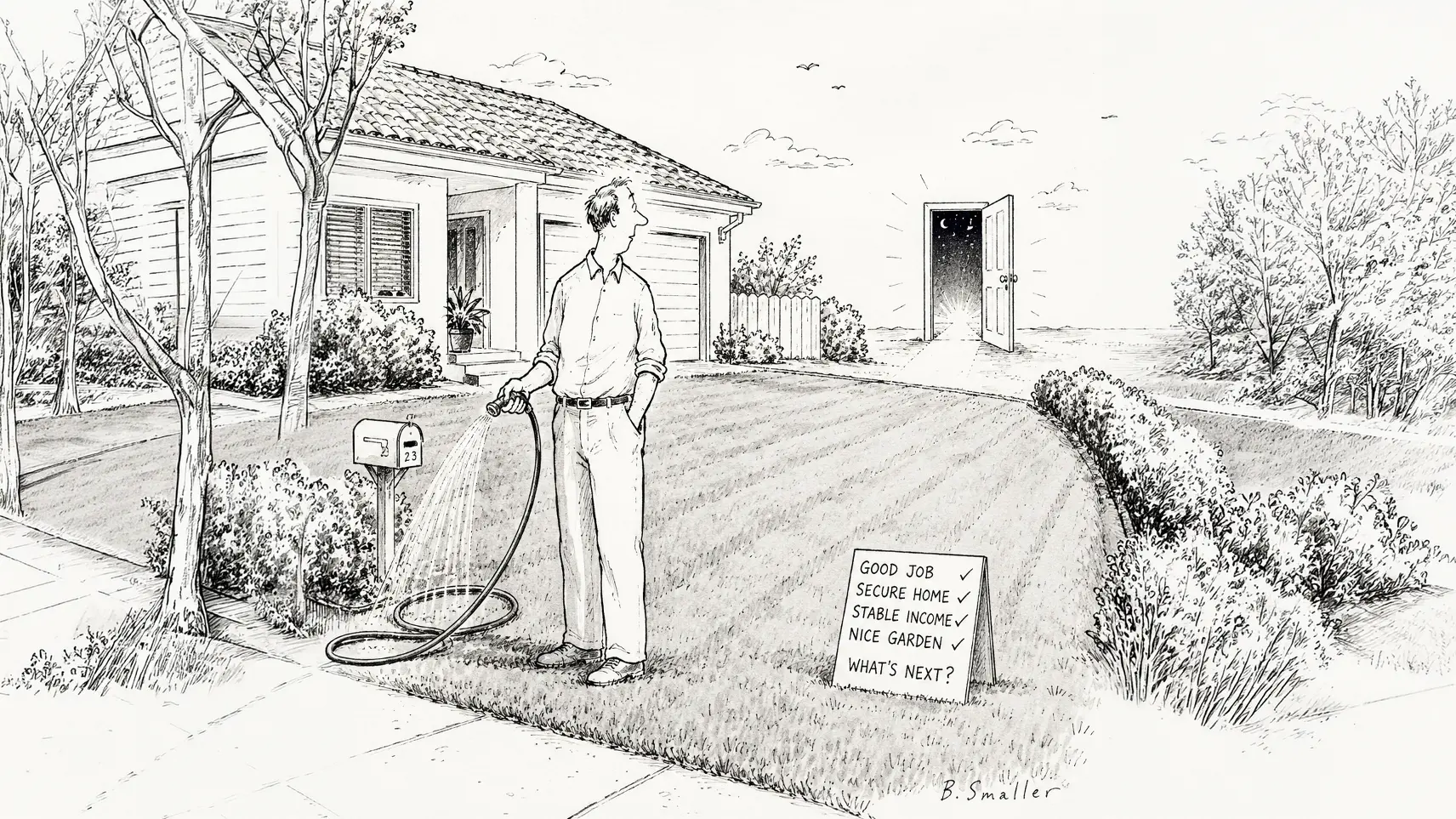
I grew up hearing the phrase “The Great Australia Dream”. It was a shorthand way of referring to the idea that home ownership on a block of land with a backyard would lead to a better life. Certainly, some elements of this that can be true—security of accommodation, being able to care for something that’s yours, and having a place to gather with friends and family can all be a part of that dream.
But even with a secure home, a fridge full of food, a stable job, some good shows to watch on TV and a nicely manicured lawn, many people describe a feeling they can’t quite name, but that sounds something like, “Is this really it?” It’s not sadness, anxiety, depression or a lack of gratitude. It’s a sense that something isn’t quite in place, even if you can’t explain what that is.
In my years practising as a psychologist, I’ve had conversations like this countless times with clients. People can have many things going well in their lives that seem to represent happiness, success and wellbeing. And yet, often what they’re still reaching for is a clearer sense of what their life is for.
two “flavours” of happiness
Often when we ask people, “How are you doing?”, what we’re really asking about is the ratio of pleasant and unpleasant feelings. Did you laugh today? Did your back ache? Did you enjoy that ice-cream you just finished? Psychologists call this hedonic wellbeing. And it’s an important part of our overall sense of wellbeing and happiness.
But it doesn’t tell the whole story of happiness and wellbeing. We know this because people in tough circumstances often still report deep satisfaction with their lives, while others with apparently comfortable lives describe feeling empty.

The ancient Greeks had a word for the kind of wellbeing that comes from the sense of deep satisfaction we can experience regardless of material circumstances: eudaimonia. It roughly translates as “a life well lived”. We experience eudaimonia, or eudaimonic wellbeing, when our lives feel like they have direction, when our actions feel meaningful and when we sense we’re becoming more of the person we aspire to be.
The psychologist Carol Ryff has studied the dimensions of psychological wellbeing for decades. What she has found consistently across cultures is that there are elements of life and living that contribute to wellbeing for all of us. The themes she has identified include good
relationships, self-acceptance, autonomy, personal growth and purpose in life. Notice what didn’t make the list: owning or buying things.
And here’s something that may surprise you . . . these factors contribute to our health and longevity too. A strong sense of purpose predicts how long you live, how often you end up in hospital, your risk of stroke, heart disease and dementia, and even how well you sleep.
The findings come from large studies tracking thousands of people over many years. Research psychologists like Patrick Hill have shown that having a sense of purpose predicts longevity even after accounting for education, income and general cheerfulness in life.
Why would that be? Well, it could be because when you’ve got something worth getting up for, you do all the small things that help to protect your health. You make appointments for checkups, you walk the dog, you call or message your friends, and you persevere through hard patches because what’s on the other side is worth the effort.
the elements of wellbeing
Purpose is one of three elements that contribute to our health and wellbeing. It’s the thing that gives an overall “shape” to our lives. The other two are also important:
Values describe the ways of living that really matter to you—being generous, being kind, being honest and grateful.
Meaning is the sense your life makes to you. When a challenge occurs, like losing a job or failing an exam, how do we make sense of that? Does it become a story of regret and disappointment, or a story of opportunity and growth? Some of the biggest personal challenges we face involve finding meaning in events that initially seem to have none.
A useful way to picture this is to think of purpose as the destination you’ve moving towards, values as the compass to guide you and meaning as the story you tell yourself about the journey.
This is where the values discussion gets really interesting. Many people would say that “the great Australian dream” is an example of a value. At a community or society level, it is. But it is not necessarily a personal value, or a value that has been personally chosen by someone after considering other options.
borrowed or owned?
Often, when we base our lives on “borrowed values”, we can still feel a sense of emptiness because some part of us knows that the life we’re living isn’t really ours. One of the most influential theories in psychology is the Self-Determination Theory. The developers of this theory, Edward Deci and Richard Ryan, have shown across several studies that we feel better and function better when our actions are personally chosen and grounded in our own values.

If you’ve never really sat with these questions, here’s an opportunity to do that right now.
Think back to a time you felt deeply alive. Not necessarily happy, but engaged and present—when you felt most like yourself. What were you doing? Who were you with? What was it about that moment that you’d like more of?
You can also try the 90-Year-Old Reflection task. Imagine yourself near the end of your life, looking back. What do you want to be able to say about the way you lived? Or think about your children or grandchildren. What do you want them to remember most about you?
These questions can help you begin moving towards seeing your own meaning, purpose and values more clearly. There won’t be a single answer here. Instead, there’ll be small thoughts, patterns and ideas that grow and change over time. Most people’s values cluster around a small set of themes: connection, learning, creativity, contribution, integrity, freedom and family.
putting it into practice
Knowing your values is only useful if you do something with them. The initial discovery is important, but it doesn’t magically create change in your life. Change comes through focus, persistence, trial-and-error, reflection and a whole ton of effort.
It might look like a very small change in your daily life, like pausing before you say yes to something and asking yourself whether it lines up with what you care about. It might mean doing one small thing every day that connects to a value, like calling your brother or sister, reading for 10 minutes, going for a walk or showing care for a neighbour. It also means noticing when you’ve drifted away from your values and gently steering yourself back without piling on shame or self-criticism.
When your behaviour matches what you care about, life feels coherent. When it doesn’t, life feels off, even though from the outside everything might appear to be in place.
The wellbeing that comes from values, meaning and purpose doesn’t feel like the wellbeing of a good holiday or a great meal. It’s slower and usually sits quietly in the background of daily life. Sometimes living by your values is uncomfortable or inconvenient. Visiting an elderly parent in care may not be fun. Choosing to donate some of your money to a charity rather than spending it on a holiday may not excite you.
But over months and years, these experiences accumulate. The life that truly feels like yours is built on those small, ordinary choices.
The great news is that you can start, or re-start, that process right now by catching yourself in the run of an ordinary week, asking what matters to you and gently shaping your time around the answer to that question.
For further reading:
- Man’s Search for Meaning by Viktor Frankl
- The How of Happiness by Sonja Lyubomirsky
- Designing Your Life by Bill Burnett and Dave Evans