
Amid the carnage of World War II, a film was released that The New York Times called “perhaps the most significant film ever produced”. The film was titled The Great Dictator and was directed by, produced by and starred the legendary comedian, Charlie Chaplin. Already a sensation in Great Britain and America, The Great Dictator was Chaplin’s first sound film and would go on to become his greatest commercial success. In it, Chaplin plays two characters: a Jewish barber and the sinister dictator Adenoid Hynkel. They are opposites: one a persecuted minority, the other a bloodthirsty despot. However, in a strange twist, the two men look exactly alike.
Set against a fictionalised backdrop of Nazi Germany, Hynkel was a not-so-subtle parody of Hitler, with the rest of the cast featuring other overt satires, such as Benzino Napaloni (Benito Mussolini), Garbitsch (Goebbels) and Herring (Göering). The film contains equal shades of light and dark, comedy and horror. Chaplin refused to make light of the dictator Hynkel, rather portraying him as irredeemably evil. However, his portrayal of the Jewish barber contains Chaplin’s trademark comedy, bringing moments of levity to the otherwise-bleak setting.
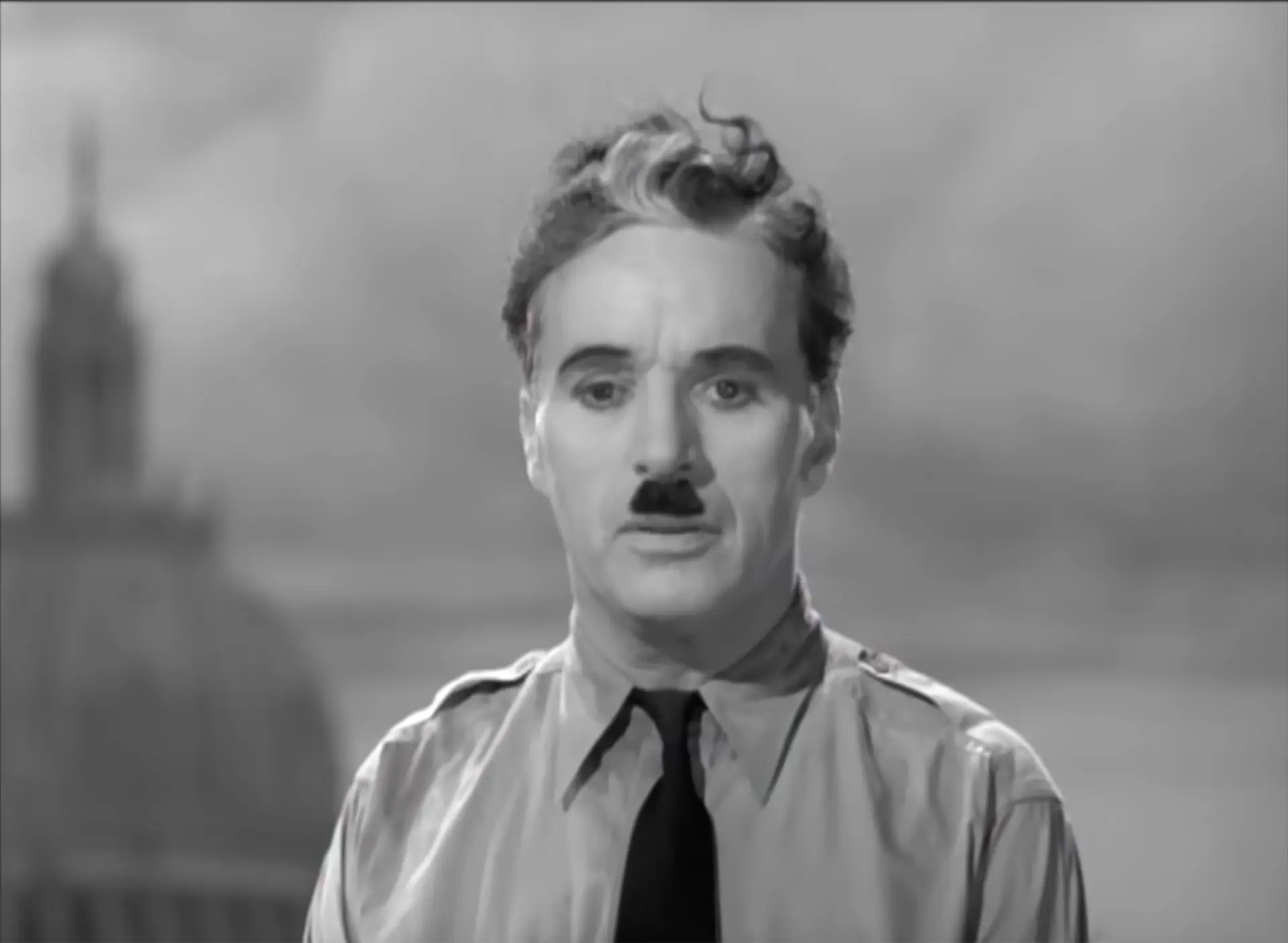
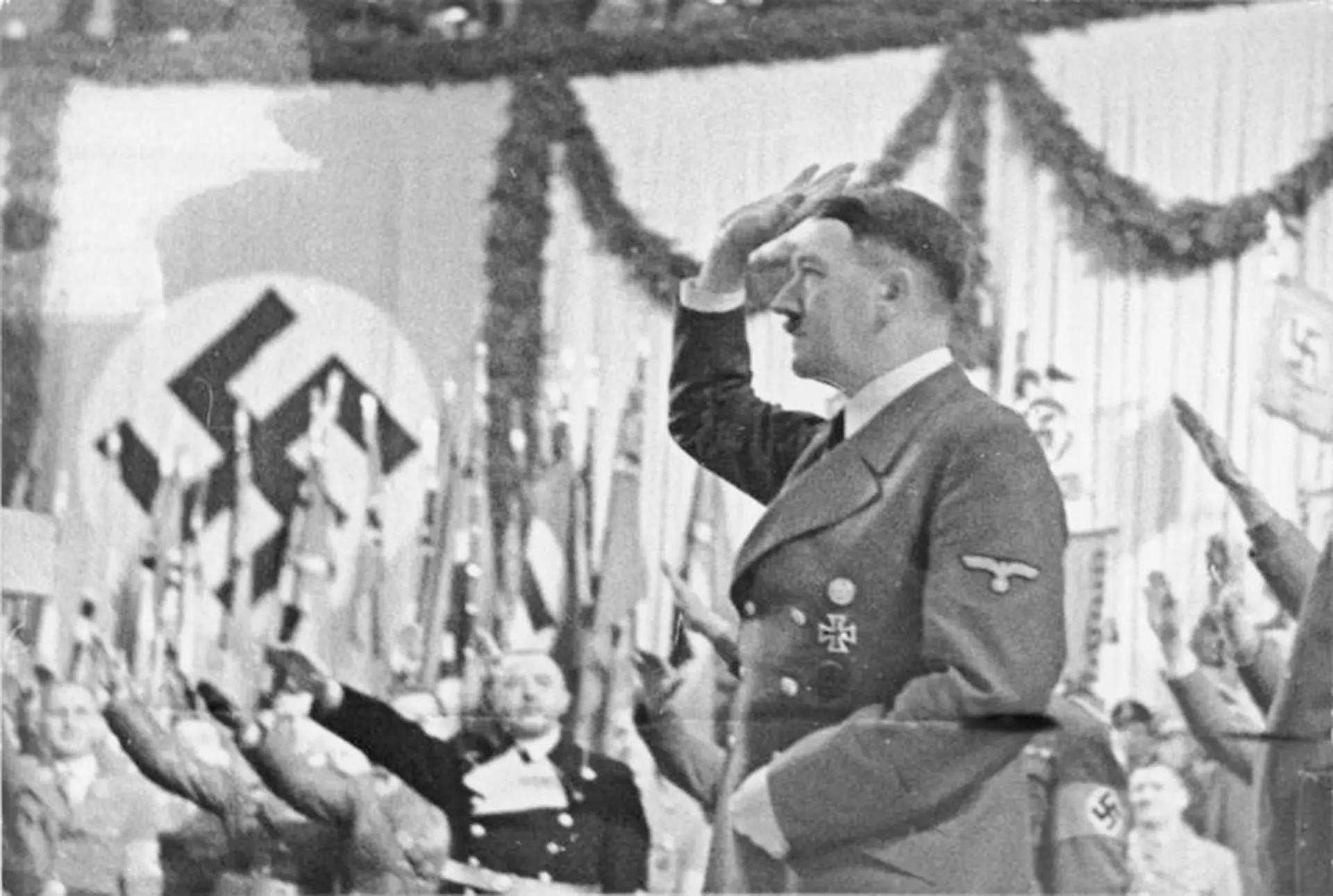
In the final act of the film, there is a great mix-up and the Fascists, mistaking him for Hynkel, give the barber the honour of delivering a great speech to the world. Turning to the men who have brutalised him and his loved ones, he makes an impassioned appeal:
“Soldiers! Don’t give yourselves to brutes. Men who despise you, enslave you, who regiment your lives. Tell you what to do, what to think and what to feel. Who drill you, diet you, treat you like cattle, use you as cannon fodder. Don’t give yourselves to these unnatural men: machine men with machine minds and machine hearts. You are not machines. You are not cattle. You are men. You have the love of humanity in your hearts. You don’t hate. Only the unloved hate. The unloved and the unnatural.”
Then, Chaplin quotes from Luke 17:20,21: “‘The Kingdom of God is within man’. Not one man, nor a group of men, but in all men!”
from satire to struggle
In the speech, Chaplin insists that dictators “free themselves but enslave the people”. Set against the backdrop of a war not yet won, the message must have been resonant, especially to the people of the Allied powers desperately trying to rebuff the advances of the Nazis. Chaplin skewers the promises of Hitler, who in claiming to be the one person capable of saving the German people from what he saw as an inevitable struggle between the “races”, enslaved his own people.
In turn, seeking salvation, men were inserted into the meat grinder of war, drugged on methamphetamines to make their blitzkrieg tactics more effective. Women were denied an education, instead being told their role was to create more Aryan children. Children were indoctrinated in Hitler Youth programs, taught that the non-Aryan (particularly the Jew) were their bitter enemy, and that only in the extermination of these “lesser races” could they be free to inherit the glorious inheritance owed to every loyal Aryan.
Don’t give yourselves to these unnatural men: machine men with machine minds and machine hearts. You are not machines. You are not cattle. You are men. You have the love of humanity in your hearts. You don’t hate. Only the unloved hate. The unloved and the unnatural.
Finally, and most horrifying of all, 11 million people from these so-called “lesser races” but also the disabled, gays, Jehovah’s Witnesses, dissenters, socialists and more were systematically rounded up and murdered over a decade. Make no mistake: the Nazis transformed Germany into a machine: a living, breathing one, consisting of millions of men, women and children, complicit in both their own enslavement as well as the enslavement of the world.
You may wonder why I invoke the memory of the Nazis in an article about AI. It’s not because of an attempt on my part to make any political comparisons from then to now—rather, it’s because I see the same tendencies embraced by Germans in the 1930s being embraced by modern Westerners today. For good or (in my opinion) ill, we’ve all been caught in the web of “progress” and in turn, become cogs in a machine.
the “great unsettling”
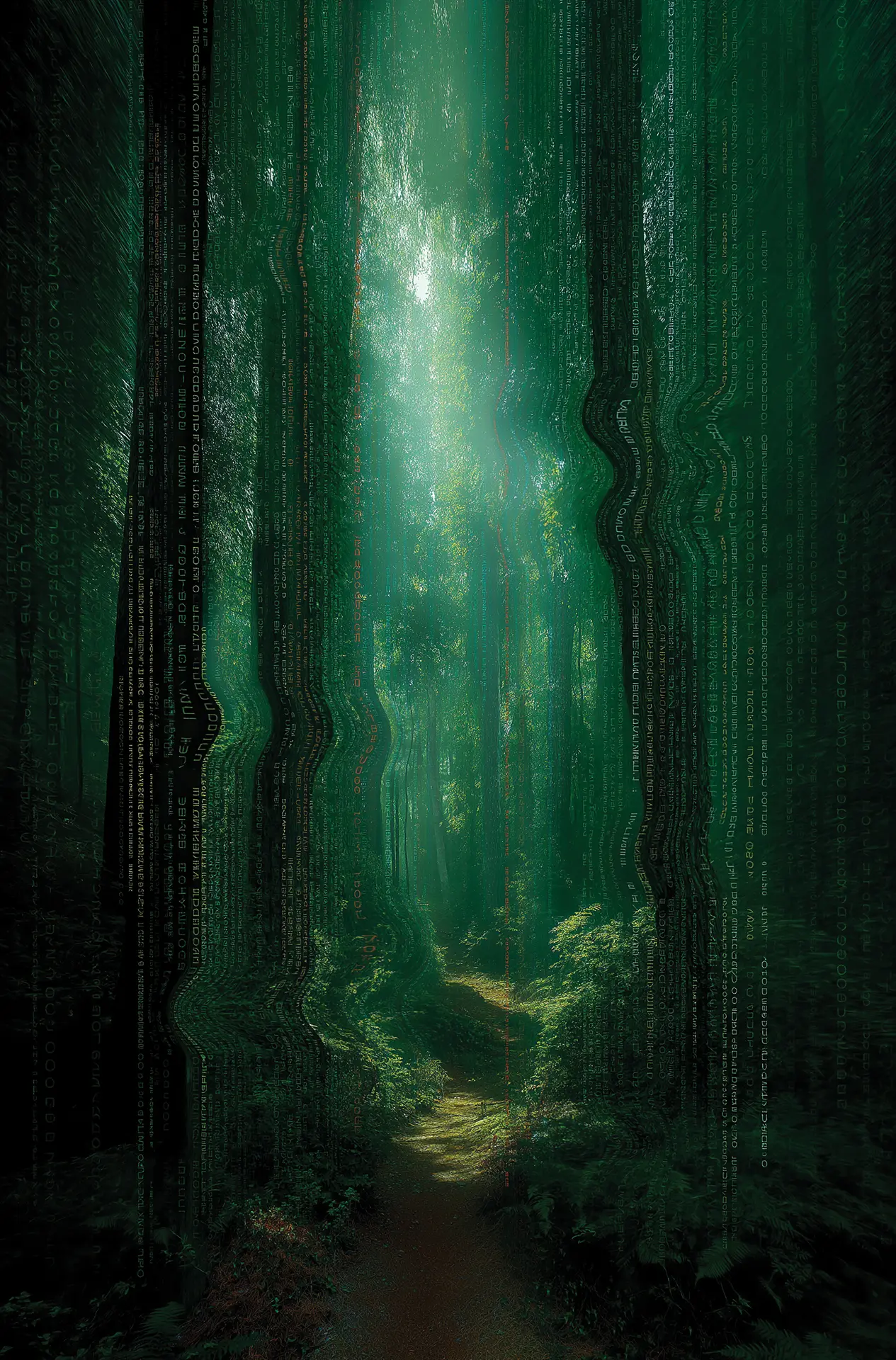
Paul Kingsnorth is (in his words) an “environmental activist turned apocalyptic mystic”. He’s explored Doaism, Sufism, Wicca and more recently, Eastern Orthodox Christianity. He believes that what English politician William Cobbett called “the Thing” and what he calls “the Machine” is an existential threat to humanity. Kingsnorth says the Machine “is destroying the life support systems of the Earth itself, razing and homogenising the mosaic of human cultures, stripping all meaning, truth and traditional support structures from our lives, and increasingly using humans as fodder in a rising digital empire which may one day supplant us.”
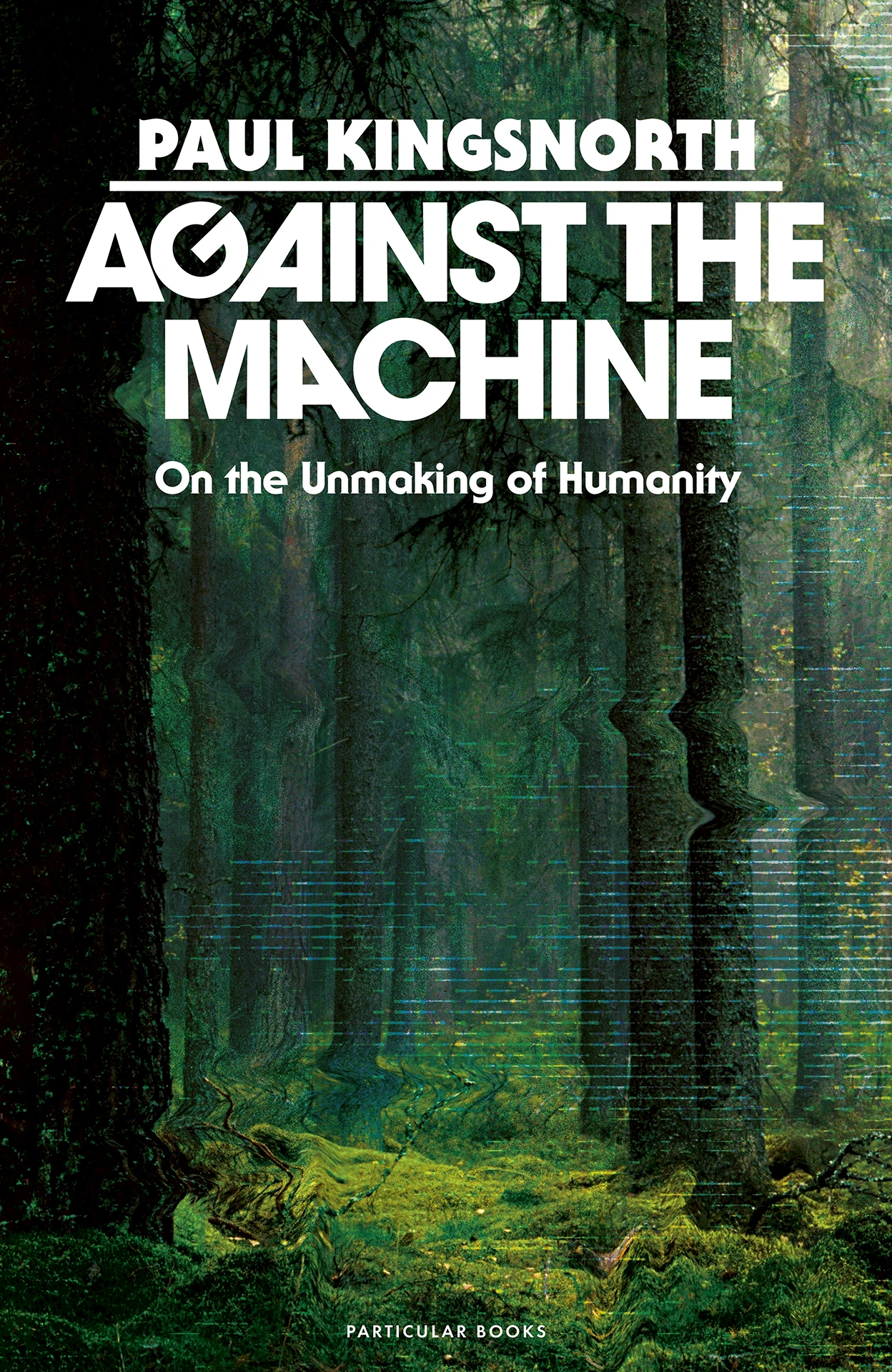
In his book Against the Machine: On the Unmaking of Humanity, he says, “I prefer to call it the Machine, because a machine—as the poets showed me—is what it feels like. This process, which has been going on for centuries, of uprooting us from nature, culture and God, leads us into a mass society, controlled by and for technology, in which we have been on course to become, since at the least the Industrial Revolution, mere cogs in a giant mechanism that we have no control over.”1
Make no mistake: Paul Kingsnorth is what a proper Englishman might call “an odd fellow”. He doesn’t fit into any of the political/social/spiritual buckets we’re used to—something he seems quite proud of. There’s plenty in his book that would offend a mainline Christian, or a capitalist, or a liberal, or any number of other “isms” that we identify with. And yet, as much as there’s plenty in his book I disagree with, there’s plenty more that disturbed me—in a good way. I think.
reclaiming our roots
In Genesis 1:26, when God makes humans, He also gives them a job: “Let them have dominion over the fish of the sea, and over the fowl of the air, and over the cattle, and over all the earth, and over every creeping thing that creepeth upon the earth.”2 I don’t usually use the King James Version, but I did this time because the term dominion has become such a powerful invocation to Christians throughout history. For many, dominion has often been synonymous with exploitation: all the earth’s resources (and in some cases, other men3) are man’s for the taking, therefore it is his divine responsibility to use them to increase his prosperity. This is not a political statement—merely an observation informed by history.
What this has created, in many cases, is marvellous. Dominion gave rise to the Industrial Revolution, motor cars, airplanes, microchips, computers and iPhones. It has given us Uber, Airbnb and TikTok. It has, in Kingsnorth’s view, also uprooted us.
Roots, he argues, are vital for human flourishing. “We need a sense of belonging that is bigger than us, across both time and space, and we underestimate that need at our peril. A rootless society is like a society with no sacred order: it is adrift, and open to capture by dangerous forces.”4 The Machine, in Kingsnorth’s mind, is humanity’s most dangerous enemy. Just as the German people became uprooted by the Nazis’ lies and thereby allowed themselves to become cogs in Hitler’s machine, so too are we all at risk of being uprooted by the lies of modernity and being caught in the modern Machine.

Recalling my previous article on AI 2027, the risk for the future is great: on the one hand, slavery and on the other, total annihilation. Of course, as the authors of AI 2027 caution, their report is not prophecy as much as it is a warning: if we wish to avoid the grim futures they predict, we will need to make better choices as a species.
Whether you agree with Kingsnorth on the finer points of his arguments or not, one thing we can all agree with is the disconnect we feel with our world. We’re more connected than ever, yet loneliness is at an all-time high. We’re wealthier than any previous generation, yet so many of us feel the overwhelming weight of financial pressure. We’re more informed than any of our ancestors, yet that knowledge hasn’t brought us peace—quite the opposite, in fact. Progress has given us ChatGPT—helping us eagerly, almost sycophantically, yet many of us harbour the suspicion that it may, one day, enslave us all—or kill us. Which is better?
I find myself returning to Chaplin’s unexpected sermon at the end of The Great Dictator. “The Kingdom of God is within man,” he said—not within a machine, a system or a ruler—but within people themselves. The danger of the Machine is not simply that it may enslave us—it already has—but that we may forget who we are. We are not consumers, data points or replaceable components in a vast technological apparatus. We are men and women made in the image of God, given dominion not to dissolve ourselves into our creations, but to steward the world with wisdom, creativity, restraint and love.
The real question facing us in the age of AI is therefore not merely what machines will become, but what humans will choose to be. If we are to avoid becoming cogs in the Machine, we will need to rediscover our roots: in communities that know our names, in traditions that ground us and in a faith that reminds us that human dignity cannot be engineered. The future is not predetermined. The path ahead will be shaped by countless small choices—by whether we surrender our humanity to convenience, or whether we insist on remaining fully human. Chaplin ended his speech with a plea: “Let us fight to free the world!” In our own quieter way, that same task remains before us today.
- Paul Kingsnorth, Against the Machine: On the Unmaking of Humanity. Thesis, 2025. ↩︎
- Scripture quotations from The Authorised (King James) Version. Rights in the Authorized Version in the United Kingdom are vested in the Crown. Reproduced by permission of the Crown’s patentee, Cambridge University Press. ↩︎
- When I use the term men, I mean both men and women ↩︎
- Ibid, Paul Kingsnorth. ↩︎