
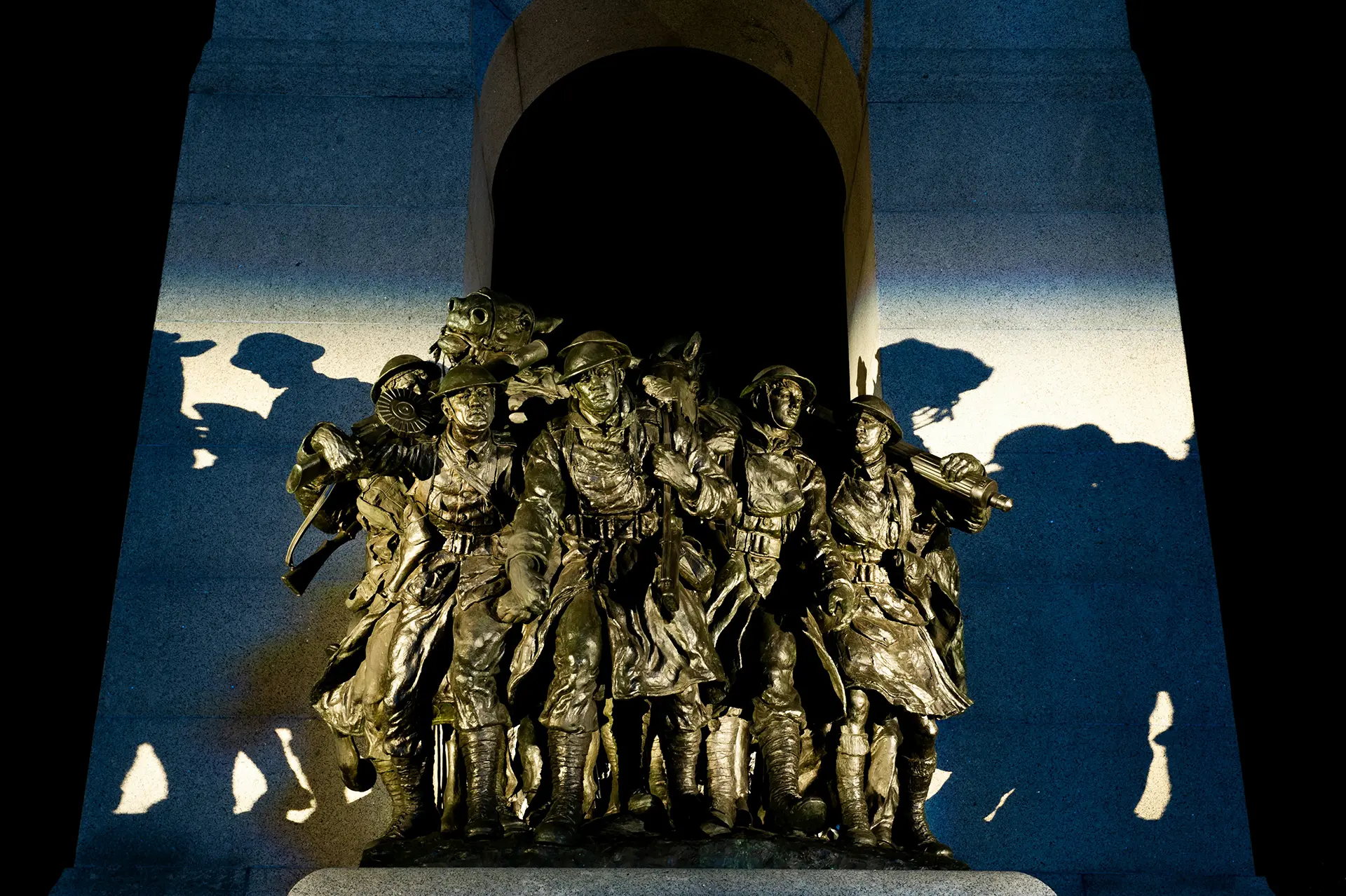
They shall grow not old, as we that are left grow old;
Age shall not weary them, nor the years condemn.
At the going down of the sun and in the morning
We will remember them.”
Who has not heard what is typically termed The Ode recited on Remembrance Day? While you may have heard these words before, what you may not know is that they are but a single stanza from a longer poem, originally seven stanzas in length.
The poem is called For the Fallen by English poet Robert Laurence Binyon. Of the seven stanzas that Binyon wrote, three are often quoted. However, it is The Ode—a memorable, four-line soundbite—that is celebrated by servicemen and the public alike.

the author of The Ode
Through his life, Binyon was a British Museum employee, Newdigate Prize for poetry winner at Oxford and an English professor at Harvard. Moreover, Binyon was a prolific writer. He published 12 books on English in the arts (often on William Blake), 18 books on Japanese and Persian artwork, one autobiography, seven stage plays and a whopping 19 books of original poetry. Notably, For the Fallen was set to music twice: first by Cyril Rootham in 1915, then by Edward Elgar in 1919.
No doubt music helped spread the popularity of The Ode. But beyond the graceful rhythms of Binyon’s words and the marvel of Elgar’s musicology, I would suggest that the power of The Ode lies in its reframing and weighty synthesis of earlier truths. It is famous, perhaps in part, because it reverences and presents in a concentrated form, biblical teachings, spiritual parallelism and soaring, lyrical phraseology.
Binyon’s father, Frederick Binyon, was an Anglican minister, while other relatives were Quakers. The annals of history are silent regarding Binyon’s mother, Mary Dockray, but we can deduce that she was a pious woman who, being united with her husband in their love of the Scriptures, carefully—even “diligently” (Deuteronomy 6:7)—instructed her children in “the nurture and admonition of the Lord” (Ephesians 6:4).

the language of The Ode
What an enviable basis for a poet, therefore, on which to meditate and build. Arguably, it was Binyon’s Christian upbringing that inspired such timeless words as: “they shall not”; a phrase that occurs 85 times in the King James Bible; “that are left” (12 times); “at the going down of the sun”, a phrase that occurs five times, with its first use specifically connected with a conditional victory in battle (the Israelites’ victory over the Amalekites is dependent on Aaron and Hur holding up Moses’ hands in Exodus 17:8–16); “in the morning” (103 times); “we shall remember” (single use).
Binyon’s parallel phrases “they shall not grow old as we grow old” and “age shall not weary them, nor the years condemn” simultaneously evoke Psalm 82:12–14, “They shall still bring forth fruit in old age” and Isaiah 40:31, “But they that wait upon the Lord shall renew their strength; they shall mount up with wings as eagles; they shall run, and not be weary; and they shall walk, and not faint.”*
Binyon’s use of the verb “shall” is deepened by his phrase “nor the years condemn” (referencing Romans 8:1). This also suggests his understanding of Isaiah 65:20. In the world to come, anyone who’s not a centenarian or more will miss out or, if I may put it in Aussie lingo, is “damn unlucky!” The person who trusts in Jesus is like a lemon tree [there’s a little man in my life who has a taste for them], that sucks up the necessary water from its environment and bears good fruit (Jeremiah 17:7,8).

our lives, an ode to the Creator
In academic circles, the ability to reason is respected—and rightly so. But where is human thought without sound, biblical instruction? Whenever we turn aside from the time-tested waymarks of the Bible, we become distracted and divorced from what matters. Given a choice between the gods of gold and silver (money), wood (construction) and stone (culture)—which secular societies reverence—or the God who created the heavens and the earth, let’s remember our Creator (Ecclesiastes 12:1). For it is not occupational narcissism, but “the fear of the Lord [that] is the beginning of wisdom” (Psalm 111:10).
That’s not to say that we should return to bartering, forsake industry or let invasive thickets grow. Like Jesus said, “Render to Caesar the things that are Caesar’s and to God the things that are God’s” (Mark 12:17). Indeed, “The secret things belong unto the Lord our God: but those things which are revealed belong to us and to our children forever, that we may do all the words of this law” (Deuteronomy 29:29). It’s not that created things, whether in their raw or manufactured state, are evil in and of themselves. It’s more a question of priorities.
I believe that Jesus is the King of the universe. If you believe that too, it doesn’t make sense to assign Him the lowest place in our lives, or to fail to give Him His dues. Sadly, though society often gives Jesus lip service, that is all it is. So, what is the antidote to self-centredness?
The Bible teaches that children are a “heritage of the Lord” (Psalm 127:3). If they truly are God’s greatest gift to us, teaching our children about Christ’s love and goodness to us will not be a burden, but our greatest achievement.

the power of shared moments
You can read about the sacrifices of Australian servicemen in history books. But you can’t understand what it really means without attending a service. This Remembrance Day, why not go out of your way to listen to someone who has risked their life so that you might have freedom? So many servicemen have died in the line of duty to their country. Can individual pursuits sometimes shield us from community awareness? Yes. Try putting yourself in a place—even a church—where you can be confronted by the real cost of sacrifice.
Shrines, memorials and cenotaphs: if ex-servicemen can respect the sacrifice made by one extraordinary man for his friends (John 15:13), his country (John 11:50) and for “the world” (John 3:16), surely everyday Australians can too! In my home, we’ve chosen not to “hide” the glory of Scripture from the next generation. Rather, we care for our kids by showing our heartfelt gratitude for Jesus. For one “thoughtful hour”, will you remember Jesus’ sacrifice?
* Scripture quotations from The Authorised (King James) Version. Rights in the Authorised Version in the United Kingdom are vested in the Crown. Reproduced by permission of the Crown’s patentee, Cambridge University Press.