

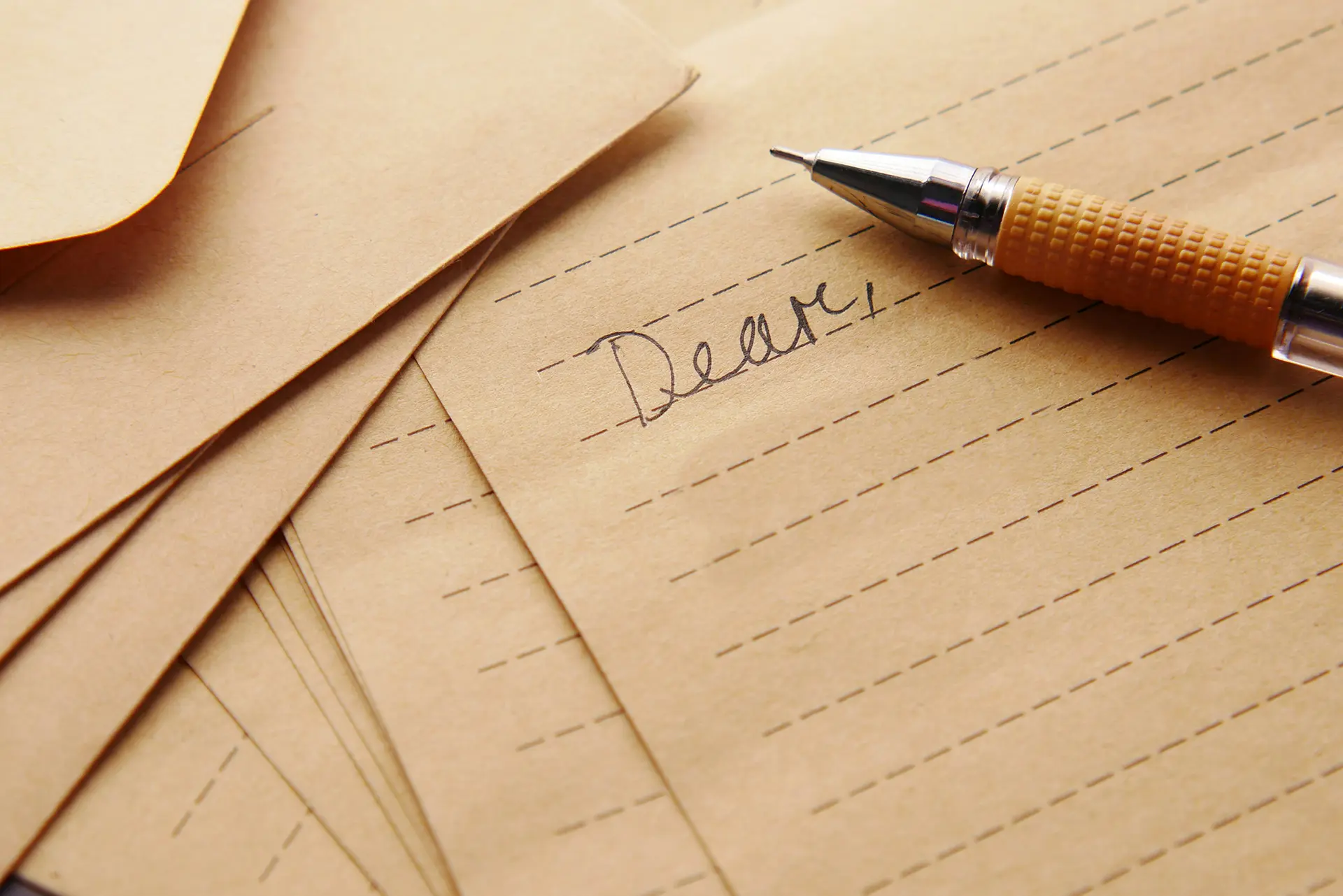
When was the last time you received a letter that wasn’t a bill, a birthday card or a real estate company sweet-talking you into selling your house? In the digital age, many of our deepest thoughts are reduced to emojis, abbreviated texts or pre-written social media greetings sent at the click of a button. It’s no wonder many of us go through life experiencing waves of loneliness and questioning our value in the world.
Writing and delivering a letter of gratitude to someone, however, can have a surprisingly powerful effect. Researchers have found that it produces some of the largest boosts in happiness of any wellbeing intervention tested.1
Take Nancy Davis Kho, for example. As she approached her 50th birthday, she decided to write a weekly thank-you letter for 50 weeks to someone who had helped, shaped or inspired her. The project impacted her profoundly. It changed how she saw the people around her, it made it easier to find the positive in life and it strengthened her relationships because recipients were so touched by her words. Most of all, it brought her an enduring sense of peace.2
We carry a weight of our own when we love and appreciate people but don’t ever tell them. Studies show that regret is more often tied to what we didn’t do rather than what we did, and when it comes to relationships, this usually means words left unsaid.3 Even positive emotions like love, appreciation and forgiveness, when surpressed, can leave us feeling like we have unfinished business.
Life offers countless small opportunities to give thanks: when someone gives us a gift, pays for our hot drink or helps us with a task. Yet often our responses come across as flat or unconvincing. When was the last time you received a thank-you and felt truly seen or appreciated?
Dr Amit Kumar, professor of wellbeing at the University of Texas, notes that people undervalue the positive effect they can have on others for a tiny investment of time and that recipients of thank-you letters often report feeling “ecstatic”.
Writing a gratitude letter is a heady tonic for both the giver and receiver. Here’s how to get started:
decide who to write to
Since this month is Mother’s Day, you might like to write to yours. Or a friend, teacher, relative or colleague.
be specific
Focus on three things: what this person did for you, how it changed you and who you’ve become because of them. Your writing doesn’t need to be prize-winning; it just needs to be authentic and honest.
keep a copy
Letters are special because they are tangible reminders you can revisit, and reflecting on them benefits you as much as the recipient.
deliver it
Ideally, deliver your letter to the person and read it to them. If that’s not possible, mail it the old-
fashioned way.
The main barrier of this exercise is pushing past the perceived awkwardness. Research shows that we consistently overestimate how awkward sending a letter like this will feel and underestimate how happy it will make the recipient.
So, what are you waiting for? Get writing. Your gratitude letter might just change someone’s life. And even if they don’t write back, you’ll still get all the juicy happiness building benefits in the process.
- Martin EP Seligman et al, “Positive Psychology Progress: Empirical Validation of Interventions” (2005, American Psychologist, Vol 60, No 5, 410–421). ↩︎
- Lunch Lady Magazine (2025, Issue 20) ↩︎
- Thomas Gilovich and Victoria H Medvec, “The Temporal Pattern to the Experience of Regret” (1994, Journal of Personality and Social Psychology. Vol 67, No 3, 357–365). ↩︎